

Robusta vs Arabica Coffee Beans: A B2B Buyer’s Sourcing Guide
Robusta vs Arabica Coffee Beans: A B2B Buyer’s Sourcing Guide
For buyers sourcing green coffee at scale, the robusta versus arabica question is not merely botanical trivia — it directly affects a buyer’s cost structure, roast profile, application suitability, and regulatory burden. Both varieties dominate global trade, but they serve very distinct purposes. Here is what procurement teams and roastery buyers need to know before placing an order.
The Key The Key Differences at a Glance
| Factor | Robusta | Arabica |
| Caffeine content | 2.7–3.5% (higher) | 1.2–1.5% (lower) |
| Body & texture | Full, heavy, thick crema | Medium, clean, lighter body |
| Acidity | Low — neutral, earthy | Higher — bright, fruity, complex |
| Flavour profile | Strong, woody, bitter | Fruity, floral, nuanced |
| FOB price tier (2026) | ~USD 3,500–5,000/tonne | ~USD 7,000–9,000/tonne |
| Supply availability | High — Vietnam dominates global supply | More variable — Brazil, Colombia, Ethiopia |
| Primary B2B application | Instant coffee, espresso blends, soluble | Specialty, filter, premium retail blends |
| EUDR risk (EU buyers) | Vietnam = low-risk country | Depends on origin country classification |
For full grading specifications (TCVN 4193:2014), screen size standards, processing methods, and defect count thresholds, see our Vietnamese Robusta Coffee Exporter sourcing guide.
Robusta Coffee Beans: What It’s Actually Good For
Robusta’s reputation used to be ‘the cheap filler bean.’ That’s changed. Specialty Robusta programs are now active in Vietnam, Uganda, and India — producing lots with cupping scores above 80 that command premiums over standard commercial grades.
Its strongest commercial case, though, remains in high-volume industrial applications. Robusta’s higher caffeine content makes it the backbone of most instant and soluble coffee manufacturing — it delivers stronger extraction at lower cost per cup. For espresso blends, a 10–30% Robusta inclusion adds crema thickness, punch, and body that straight Arabica blends can struggle to achieve without over-roasting.
From a supply standpoint, Vietnam produces about 40% of the world’s Robusta — roughly 96% of its total coffee output — giving it unmatched volume capacity for large-format sourcing contracts. The USDA FAS forecasts Vietnam’s production at 30.8 million 60-kg bags for 2025/26, rising to 32.5 million in 2026/27 (USDA FAS, May 2026). If buyers need consistent supply across multiple shipments per year, Robusta from Vietnam is one of the few origins that can deliver it. Explore Famous robusta coffee growing regions in Vietnam. (https://export.tamtrinhcoffee.com/famous-robusta-coffee-growing-regions-in-vietnam/)
Arabica Coffee Beans: Where It Earns Its Premium
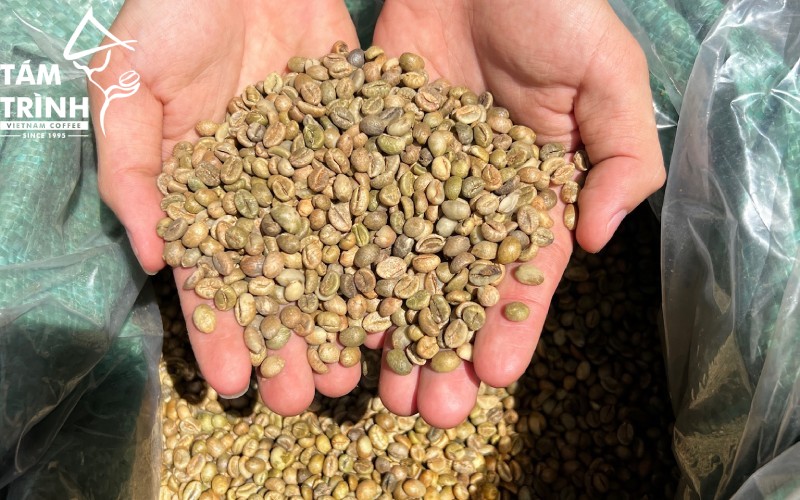
Arabica’s lower caffeine content and higher sugar levels produce the complexity buyers in specialty and premium retail segments are willing to pay for. Fruity, floral, and bright acidity — characteristics that define high-scoring Arabica lots from Ethiopia, Colombia, and Vietnam’s Cầu Đất region — simply aren’t replicable in Robusta at commercial scale.
The tradeoff is price and supply risk. Arabica futures hit a record USD 4.41 per pound in February 2025 — nearly double Robusta’s peak in the same period — and the variety is significantly more sensitive to weather disruption. Brazil’s Arabica crop was cut by drought in 2024; Colombia’s output has been volatile for several consecutive seasons. For buyers building long-term supply contracts, that price and availability risk needs to be built into your sourcing strategy.
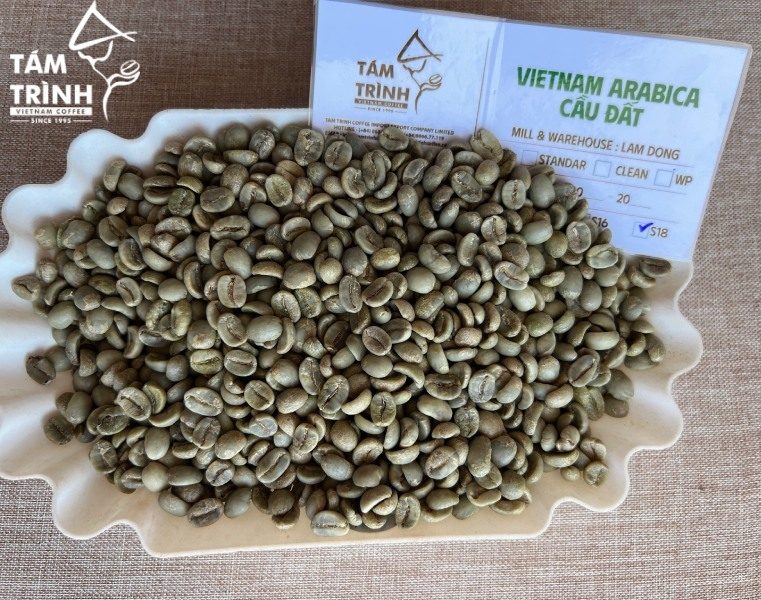
Vietnam’s Arabica, grown primarily in Cầu Đất (Lâm Đồng) at altitudes 1,200 – 1650 metres and Sơn La at altitudes above 1,000 metres, offers an emerging alternative. Volumes are smaller than Brazilian or Colombian origins, but quality in certified and carefully processed lots is competitive for specialty blending applications.
Meeting with coffee enthusiasts at Tam Trinh in lam ha, Lam Dong, Vietnam
See Vietnamese Arabica Coffee: characteristics, Flavor Profile, and Growing Regions. (https://export.tamtrinhcoffee.com/vietnamese-arabica-coffee/)
Which Coffee Beans Should You Source?
The honest answer: most commercial buyers need both, just in different ratios depending on their application. Here’s a simple decision framework:
| Your Application | Recommended Spec | Why |
| Instant / soluble manufacturing | Robusta Grade 1–2, Washed Process | Higher caffeine, better extraction yield, lower cost per tonne |
| Commercial espresso blend | 70–80% Arabica + 20–30% Robusta | Robusta adds crema and punch; Arabica adds flavour complexity |
| Specialty / single origin | Arabica, screen 17+, washed or natural | Cupping profile is the product; origin and process matter |
| Private label / OEM roasted | Arabica base, optional Robusta addition | Depends on price point — premium PL uses Arabica; value PL blends in Robusta |
| Cold brew concentrate | Natural Robusta or natural Arabica | Natural process adds body and sweetness to concentrates |
If a buyer’s primary driver is cost efficiency at high volume, Robusta — particularly Vietnamese Robusta — stands as the strongest option. Should the end product justify an Arabica price premium, Vietnamese Arabica from Lâm Đồng offers a competitive quality-to-cost ratio compared to Latin American origins at current FOB levels.
Explore our green Robusta beans – commercial grade, washed, Honey, and Natural here : https://export.tamtrinhcoffee.com/product-category/green-robusta-beans/.
Plus, see the washed and natural process of Green Arabica Beans in Cầu Đất & Lâm Hà origin. https://export.tamtrinhcoffee.com/product-category/green-arabica-beans/
– View Tám Trình Coffee’s Robusta and Arabica product specifications
Compare grading standards, processing profiles, and certification options side by side.
– Request a sample lot before committing to a bulk order
WhatsApp/Hotline: 088 6677 238
Email: admin@tamtrinhcoffee.com Respond within 1 business day with a full product spec sheet and pricing based on your volume and specifications.
FAQ: Frequently Asked Questions
Q1: Can Robusta replace Arabica in specialty coffee applications?
Not directly — at least not yet at scale. Specialty Robusta (cupping score 80+) is growing, particularly from Vietnam and Uganda, but volumes are limited and pricing has risen to reflect that. For commercial espresso or premium blends, Robusta is best used as a component alongside Arabica, not as a straight replacement.
Q2: Why is Robusta cheaper than Arabica if it has more caffeine?
Caffeine content doesn’t drive market pricing — cup complexity and consumer preference do. Arabica’s more delicate flavour profile commands a premium in specialty and retail markets. Robusta’s higher yield per hectare and lower production costs also mean more supply hits the market at lower price points. That said, the gap has narrowed significantly since 2024 as Robusta’s industrial demand outpaced supply.
Q3: Does Robusta from Vietnam taste different from Robusta from Uganda or Brazil?
Yes — origin matters even within Robusta. Vietnamese Robusta from the Central Highlands tends to have a clean, neutral, dark chocolate profile with a good body. Ugandan Robusta from the Rwenzori region often shows more fruit and earthiness. Brazilian Conilon Robusta is typically more neutral and widely used in soluble blends. Specify origin in your contract if cup consistency matters across shipments.
Q4: Is Vietnamese Arabica EUDR compliant?
Vietnam is classified as ‘low-risk’ by the EU under the EUDR framework. Both Arabica and Robusta from compliant Vietnamese exporters can be accompanied by EUDR due diligence documentation from December 2026. Ask your supplier whether they’re enrolled in MARD’s national geotraceability database, launched in December 2024.
Q5: What’s the minimum order quantity if I want to source both Robusta and Arabica from the same Vietnamese exporter?
Standard MOQ is one 20-foot container per variety — approximately 18–20 metric tonnes per lot. Some exporters allow mixed-container arrangements for established buyers, but this typically requires advance arrangement and may affect blending documentation. Confirm in writing before contracting.
Conclusion
Robusta and Arabica aren’t competing products — they’re complementary tools in a sourcing strategy. Knowing when to use each, and what specifications to demand from your supplier, is what separates buyers who manage supply risk from those who react to it. Tám Trình Coffee supplies both export-grade green Robusta (TCVN 4193:2014) and Arabica from Lâm Hà and Cầu Đất — with full traceability documentation for EU and global markets.