


Why Did Coffee Prices Decline in Early 2026?
Entering 2026, the global agricultural commodity market has experienced many notable fluctuations, with coffee prices becoming one of the most discussed topics. After a strong surge during 2024–2025, the decline in coffee prices at the beginning of 2026 surprised many people in the industry—from farmers and businesses to investors.
So, what caused this shift? The article below will help you better understand the nature of coffee price fluctuations in 2026 from an in-depth perspective.
How Did Coffee Prices Change in 2026?
After reaching a peak at the end of 2025, coffee prices began to slow down and entered a correction phase. The decline was not sudden but occurred gradually, accurately reflecting the supply-and-demand dynamics of the commodity market.
During 2024–2025, coffee prices increased sharply due to concerns over global supply shortages, especially from major producing countries. However, as these concerns gradually eased, the market entered a correction cycle. Therefore, the decline in early 2026 was essentially a natural reaction after an excessively rapid growth period.

Why Did Coffee Prices Decline in Early 2026?
This is the question most people interested in coffee prices are trying to answer. In reality, the decline resulted from a combination of multiple factors.
Global Supply Increased Again
Brazil plays a key role as the benchmark country in the global coffee supply market. Changes in Brazil’s production directly determine global price trends.
In previous years, Brazil suffered severe droughts and cold weather caused by El Niño, leading to crop failures and damaged coffee trees. At that time, coffee became scarce and prices surged dramatically.
However, entering early 2026, weather conditions in Brazil improved significantly. Rainfall became more evenly distributed, allowing Arabica coffee trees to recover and achieve outstanding productivity. As the world’s largest coffee exporter released more inventory into the market, supply shortage concerns eased rapidly.

Not only Brazil, but Vietnam—the world’s largest Robusta supplier—also recorded positive production data. Field analyses showed that Vietnam’s 2025–2026 crop output was estimated to increase by approximately 10%.
As a result, when supply increases, downward pressure on coffee prices becomes inevitable.
Slower Consumption Demand
Besides supply, consumer demand is another important factor affecting coffee prices.
In the context of an unstable global economy, consumers tend to tighten spending. This directly impacts non-essential products, including coffee in certain segments. Demand decreased slightly, but enough to create short-term price pressure.
Profit-Taking Activities by Investors
The coffee market is not only about farmers and businesses; large investment funds also participate heavily.
After coffee prices rose sharply over a long period, many investors began taking profits. Large selling volumes within a short time dragged prices downward. Although this is a financial factor, it strongly affects coffee price volatility.
The Impact of Exchange Rates
One factor that receives less attention but significantly impacts coffee prices is exchange rates.
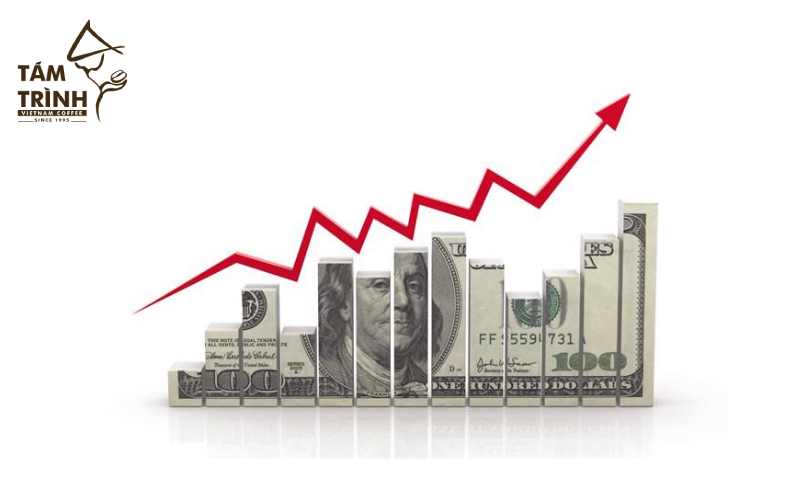
Globally, coffee is traded in US dollars (USD). At the beginning of 2026, the USD appreciated strongly in international markets.
Imagine a coffee importer in Europe or Japan wanting to purchase Vietnamese coffee. They must exchange their local currency into USD before paying exporters. When the USD becomes more expensive, they need to spend more money to buy the same amount of coffee as the previous year.
How Does Falling Coffee Prices Affect the Market?
A decline in coffee prices is not just about numbers—it impacts the entire coffee value chain.
Impact on Farmers
Farmers are the group most directly affected when coffee prices decline.
Lower income forces them to reconsider investment costs for future crops, potentially affecting long-term quality and production output.

Opportunities for Roasting and Export Businesses
On the other hand, lower coffee prices create opportunities for businesses.
Lower raw material costs help optimize profits, especially for companies with effective inventory strategies. This can be an ideal time for businesses to prepare for the next upward price cycle.
Impact on Consumers
For consumers, the impact of falling coffee prices is not always immediately visible.
Retail prices may not decrease right away because they still depend on many other factors. However, in the long run, the market may offer more competitively priced products.
Coffee Prices in 2026: Opportunity or Risk?
When observing coffee price fluctuations, the important thing is not whether prices rise or fall, but how you understand and respond to those trends.
Long-Term Market Perspective
In the long term, coffee prices remain heavily influenced by climate change and global consumption demand.
Coffee-growing areas in some regions are shrinking, while demand continues to increase. This suggests that future price growth potential still exists.
Strategies for Different Stakeholders
For Farmers
The core solution is reducing dependence on chemical fertilizers to lower production costs while applying 100% ripe cherry harvesting standards combined with advanced processing methods such as Honey and Natural processing.
For Trading Businesses
Establishing hedging strategies on commodity exchanges and investing deeply in roasting and finished-product technology can create stronger foundations against market fluctuations.
The transition from raw material exports to value-added processing is the only sustainable way to protect profit margins against global coffee price volatility.
For Investors
Closely monitoring coffee price movements helps investors make more accurate decisions.
Partner with Tam Trinh Coffee
In the face of constant agricultural market fluctuations, choosing a reliable supplier is the key to protecting your business.
With more than 30 years of experience from coffee farming to international exports, Tám Trình Coffee understands that only authentic quality creates sustainable value.

Regardless of whether coffee prices rise or fall, Tám Trình Coffee remains committed to:
- Supplying high-quality Robusta and Arabica green coffee beans with multiple processing methods (Washed, Honey, Natural)
- Providing pure roasted coffee and specialty coffee with consistent quality
- Maintaining 100% transparency in harvesting, processing, and advanced roasting systems
- Offering flexible and stable pricing policies for both export and domestic markets while maximizing competitiveness for importers, distributors, and café partners
Conclusion
The decline in coffee prices at the beginning of 2026 is not entirely negative but rather part of a normal market cycle. From a broader perspective, it is a necessary correction after a period of rapid growth.
What matters most is understanding the true nature of coffee price fluctuations so you can make informed decisions—whether you are a farmer, business owner, investor, or consumer.
In an increasingly volatile market, staying informed and maintaining a long-term perspective will help you remain proactive and confident amid changing coffee prices.
FAQ: Coffee Prices in 2026
Why did coffee prices decline in early 2026?
Coffee prices declined mainly because global supply increased significantly, especially from Brazil and Vietnam. At the same time, consumption demand slowed, while exchange rate fluctuations and profit-taking activities by speculative funds created additional downward pressure.
Will coffee prices continue to decline sharply in 2026?
The possibility of a deeper decline depends on many factors such as crop output, weather conditions, and market demand. In the short term, prices may continue correcting, but in the long term they still have recovery potential if supply disruptions occur or demand rises again.
What factors currently affect coffee prices the most?
Major factors include production output in key exporting countries, climate change, logistics costs, USD exchange rates, and speculative activities in commodity markets.
Do falling coffee prices affect farmers?
Yes. Lower coffee prices directly reduce farmers’ income. This may force them to reduce investment in crop care, affecting both quality and productivity in future harvests.