


A Complete Guide to Popular Coffee Roast Levels and Their Impact on Flavor
In coffee processing technology, coffee roast levels are the most important variable determining the sensory characteristics of the final product. From the same green coffee beans, simply changing the roasting time and temperature can create completely different flavor profiles.
Choosing the right roast level depends not only on personal preference but is also closely related to the coffee variety (Arabica or Robusta), terroir, and intended brewing method. This is also a core factor in product development strategies for professional coffee brands.
Classification of Coffee Roast Levels Based on Technical Standards
To better understand common coffee roast levels, it is necessary to look at how professional roasters classify them. Typically, they use color scales, finishing temperatures, and important milestones such as the “First Crack” and “Second Crack.”
In general, coffee roast levels are divided into three main categories, each representing a different stage of physical and chemical transformation inside the bean.
Light Roast (Light Roast / Cinnamon Roast)
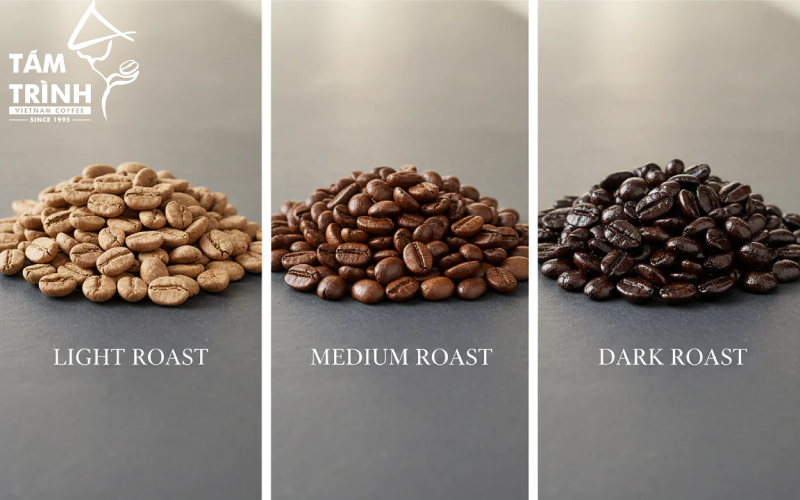
Among common coffee roast levels, Light Roast is stopped right when the first crack begins (bean temperature around 195°C–205°C). At this stage, the beans are light brown, dry on the surface, and almost oil-free. This roast level preserves the original characteristics of the coffee bean as much as possible, making it especially suitable for high-quality Arabica coffees.
In terms of flavor, Light Roast stands out with bright acidity, fruity or floral notes, gentle sweetness, and very little bitterness. This happens because the development time is short, and the bitter compounds formed from CGA breakdown and advanced caramelization reactions have not yet become dominant, preserving the highest concentration of natural organic acids.
Because of these characteristics, Light Roast is commonly used for brewing methods such as pour-over (V60), Chemex, and cold brew—methods that highlight delicate flavor layers.
Medium Roast (Medium Roast / City Roast)
When discussing common coffee roast levels, Medium Roast is the most widely used option due to its balanced flavor profile. Coffee beans at this level are removed sometime between the first crack and before the second crack begins (approximately 210°C–218°C), resulting in a medium brown color, sometimes with a slight reddish tint.
Compared to Light Roast, acidity is reduced while body becomes fuller, creating a richer mouthfeel.
Medium Roast has a longer development time, allowing Maillard reaction products such as melanoidins to accumulate, creating a fuller body. At the same time, deeper caramelization and stronger breakdown of organic acids and CGAs reduce acidity while increasing quinic bitterness, forming balanced chocolate and roasted nut notes.
Because of the harmony between acidity, body, and aroma, this roast level is suitable for many brewing methods such as Syphon, French Press, and AeroPress. It is also considered a safe choice for cafés serving a wide range of customers.

Dark Roast (Dark Roast / French Roast / Italian Roast)
At the highest level among common coffee roast profiles, Dark Roast is completed when the second crack begins or becomes intense (above 225°C).
At this point, the beans are dark brown to nearly black, and the surface is usually covered with shiny oils caused by lipids being pushed outward under high temperatures.
In terms of flavor, Dark Roast almost completely loses acidity, replacing it with strong bitterness, smoky notes, dark chocolate flavors, and sometimes slight burnt characteristics. This is the result of sugar carbonization and the near-complete breakdown of acidic compounds inside the bean.
Although Dark Roast no longer retains the complex flavor layers of Light Roast, it is highly suitable for strong coffee preferences, especially for Espresso, traditional Vietnamese phin coffee, and milk-based coffee drinks.
Changes in Coffee Beans Across Roast Levels
To better understand coffee roast levels, you need to recognize the transformations occurring inside the coffee bean as temperature increases.
Acidity
Acidity is an important factor that creates brightness in coffee flavor. As roasting becomes darker, organic acids gradually break down.
This explains why Light Roast has bright acidity while Dark Roast contains almost none.
Body
Body refers to the thickness and mouthfeel of coffee.
Among common roast levels, body typically peaks between Medium and Medium-Dark roasts. When roasting becomes too dark, the bean structure breaks down heavily, causing body to become “heavy yet hollow.”

Aroma & Flavor
Flavor transformation is the most interesting aspect of coffee roast levels.
- Light Roast → Floral and fruity notes
- Medium Roast → Caramel and chocolate notes
- Dark Roast → Smoky, spicy, and dark cocoa notes
Choosing the Right Roast Level for Business Needs
In real-world operations, selecting the right roast level is not only about taste—it is also a business strategy.
For Specialty Coffee Shops
Specialty coffee shops often prioritize Light to Medium-Light roasts.
The goal is to maximize the origin characteristics of Arabica beans, allowing customers to experience complex and diverse flavors.
For Traditional Vietnamese Phin Cafés
In Vietnam, Medium-Dark to Dark Roast is the preferred choice.
Vietnamese consumers often favor strong bitterness and long-lasting aftertaste, especially when combined with condensed milk.

For Espresso Machines
Espresso requires balance between acidity, body, and crema.
Therefore, Medium or Medium-Dark roasts are commonly used to ensure stable extraction and beautiful crema formation.
Roast Consistency Control in Professional Coffee Businesses
For professional roasting companies, maintaining consistency across roast levels is essential.
At Tám Trình Coffee, we apply strict quality control systems to ensure every roast batch meets uniform standards.
Agtron Color Measurement System
The Agtron system precisely measures coffee bean color after roasting, eliminating errors caused by visual evaluation.
This is especially important in large-scale production, where even small inconsistencies can affect the entire product line.
Professional Roast Profile System
Each product line has its own roasting profile chart.
This system stores and accurately reproduces all roasting parameters such as temperature, roasting time, and Rate of Rise (RoR), ensuring consistent roast quality from batch to batch.
Connect with Tám Trình Coffee – Roasting Art from Passion and Expertise
Choosing the right roast level is not just a technical process—it is an art of awakening the soul of the coffee bean.
At Tám Trình Coffee, we do not simply sell coffee; we provide optimal flavor solutions tailored to every customer and partner.

Why Choose Tam Trinh Coffee’s Roasting Services?
- Sustainable coffee sourcing from Lam Ha, Lam Dong
- International certifications such as 4C and UTZ
- Modern roasting technology with professional profile management systems
- Experienced roasting experts deeply understanding the physical and chemical characteristics of each coffee variety
- 100% pure roasted coffee with no additives, preserving the authentic highland flavor
Looking for the perfect pure roasted coffee for your café or export project? Contact Tám Trình Coffee today for expert consultation, free samples, and the experience of freshly roasted coffee at its finest.
Conclusion
Understanding common coffee roast levels not only enhances your coffee experience but also helps optimize business performance in the coffee industry.
Each roast level has its own personality, suitable for different customer groups and brewing methods. By choosing the right roast, you are not just selling coffee—you are delivering a complete experience.
At Tám Trình Coffee, with extensive experience in coffee roasting, we are always ready to help you find the ideal roast profile for your brand.
FAQ – Frequently Asked Questions
Which roast level contains the most caffeine?
The caffeine content inside the bean does not significantly change between light and dark roasts. However, roasting changes bean mass differently, affecting caffeine density.
- Robusta: approximately 3–4% caffeine by bean weight
- Arabica: approximately 1–2% caffeine by bean weight
Why do dark roasted beans develop oil quickly?
High temperatures break down the cellulose structure of the bean, causing natural oils (lipids) to rise to the surface more rapidly.
Can different roast levels be combined in one coffee package?
Yes. This is called post-roast blending, a method used to create more complex and balanced flavor profiles.