


The Journey from Coffee Bean to Cup at Tam Trinh Coffee
To create a delicious cup of coffee that awakens all the senses, coffee beans must go through a long and meticulous journey. It is not merely a story of brewing equipment or barista skills, but a closed-loop supply chain that requires attention to detail from the farm to the final cup. Join Tám Trình Coffee in exploring the journey from coffee bean to cup and discover the value behind every drop of coffee.
The Journey from Coffee Bean to Cup
The journey from coffee bean to cup is the intersection of nature, farmers’ dedication, and modern technology. At Tám Trình Coffee, this journey is defined by transparency, sustainability, and exceptional quality.
Every stage—from cultivation, harvesting, processing, and roasting to brewing—is carefully standardized. This ensures that the finest characteristics bestowed by the Central Highlands are preserved in every cup.

Step 1: Coffee-Growing Regions in Lam Dong
The foundation of a great cup of coffee always begins at its roots—the land where coffee is grown. Lam Dong is recognized as one of the regions with the most ideal natural conditions for coffee cultivation.
Advantages of Lam Dong’s Coffee-Growing Regions
Tám Trình Coffee sources its coffee from Lam Dong, where coffee is cultivated at elevations ranging from 800 to 1,500 meters above sea level. This region enjoys a cool temperate climate year-round, significant day-to-night temperature variations, and fertile basalt soil.
These natural conditions create an ideal environment for coffee cultivation, particularly for the two main coffee varieties grown here: Robusta and Arabica.
Partnering with More Than 3,000 Farming Households
Recognizing that the strength of the coffee value chain lies with the farmers, Tám Trình Coffee has established a sustainable network with more than 3,000 farming households across Lam Dong.
In addition, Tám Trình Coffee supports local farmers through technical training programs, regenerative agriculture initiatives, and stable purchasing agreements, helping improve the economic well-being of highland communities.
Tám Trình Coffee Partners with More Than 3,000 Coffee Farmers
Step 2: Coffee Tree Care at the Farm
Only healthy coffee trees can produce high-quality coffee cherries. Coffee farms within Tám Trình Coffee’s network strictly follow sustainable and safe cultivation practices.
Soil and Water Management
Clean irrigation water is used, while native grasses and vegetation cover are maintained to reduce soil erosion and preserve natural moisture.
Organic Nutrition
Priority is given to organic fertilizers and microbial compost made from recycled coffee pulp to promote long-term soil health.
Limited Chemical Use
Pests and diseases are controlled through biological methods, minimizing the use of chemical pesticides to ensure that green coffee beans remain clean and safe for international quality testing.
Step 3: Harvesting Ripe Coffee Cherries
Harvesting marks the transition from farming to coffee processing.
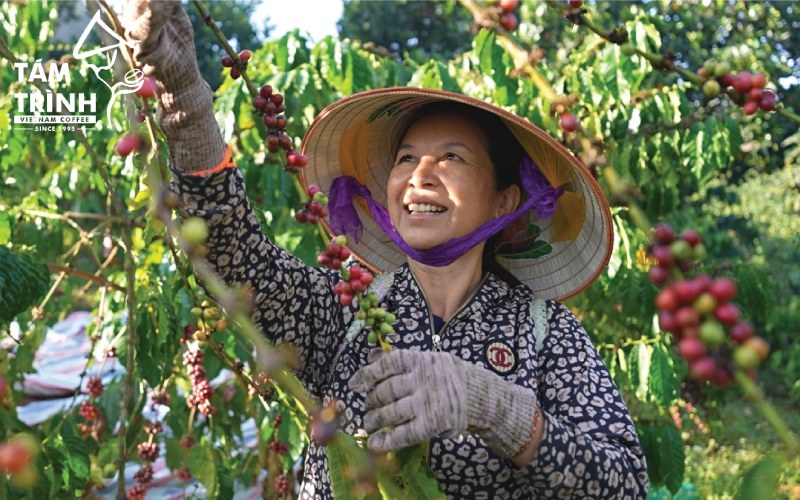
Unlike mass strip-picking methods, Tám Trình Coffee’s partner farms commit to selective hand-picking.
Workers harvest only fully ripe red or yellow cherries. For premium lots, Tám Trình Coffee maintains a ripeness rate exceeding 95%.
Uniformly ripe cherries help eliminate the astringency associated with green fruit and create the ideal conditions for controlled fermentation in the next processing stages.
Step 4: Coffee Processing — Natural, Washed, and Honey
Immediately after harvesting, fresh cherries are transported to the processing facility on the same day for sorting and processing.
Depending on the desired flavor profile, Tám Trình Coffee applies one of three core processing methods.
Natural Processing
With this method, fully ripe coffee cherries are dried intact with both skin and fruit pulp still attached.
Natural sugars from the fruit gradually penetrate the bean during drying, resulting in:
- Intense tropical fruit flavors
- Deep sweetness
- Heavy body
Washed Processing
In the Washed process, coffee cherries are passed through a depulping machine to remove the outer skin.
The beans are then fermented to remove the mucilage surrounding the parchment before being thoroughly washed with clean water.
This method highlights:
- Bright acidity
- Delicate floral aromas
- Exceptional cup cleanliness
Honey Processing
For Honey processing, the outer skin is removed while part of the sugar-rich mucilage is intentionally retained during drying.
Depending on the amount of mucilage left on the bean, different flavor profiles and color classifications are achieved.
This method offers a remarkable balance between the bright acidity of Washed coffee and the smooth sweetness of Natural coffee.

Step 5: Drying and Moisture Control
After processing, coffee must be dried to a safe moisture level.
Tám Trình Coffee utilizes modern greenhouse drying systems combined with raised drying beds elevated above ground level.
Workers regularly turn the coffee to ensure even drying and prevent cracking or localized mold development.
Once moisture reaches the ideal range of 11–12.5%, the drying process is completed.
The coffee then enters a resting period of 4–8 weeks, allowing flavors to stabilize and mature.
Step 6: Hulling and Green Coffee Production
After the resting period, the coffee enters the factory’s dry milling line.
Modern hulling machines gently remove the parchment layer through carefully controlled friction, ensuring the green coffee beans remain intact and undamaged.
At the end of this stage, high-quality green coffee beans are produced.
Step 7: Grading and Quality Control
To meet export standards and satisfy demanding B2B customers, Tám Trình Coffee subjects its green coffee beans to a multi-stage grading system.
Size Screening
Beans are graded according to standardized screen sizes to ensure roasting consistency.
Density Separation
Lightweight, porous, and insect-damaged beans are removed.
Color Sorting
Advanced color sorters identify and eliminate defective beans based on color abnormalities.
Quality Control (QC)
Coffee experts perform physical inspections, moisture testing, and sensory evaluation to score and classify each lot according to quality standards.

Step 8: Coffee Roasting — Awakening Flavor Within the Bean
Coffee roasting is both a science and an art, transforming flavor precursors inside green coffee beans into hundreds of aromatic compounds through heat.
Tám Trình Coffee utilizes modern roasting technology that ensures even roasting from the inside out while minimizing scorching.
Each coffee variety and processing method follows a unique roast profile.
Roasters carefully control temperature and roasting time to highlight the most distinctive flavor characteristics of each coffee.
Step 9: Grinding and Brewing Coffee
This is the final stage of the journey from coffee bean to cup at Tám Trình Coffee.
After roasting, coffee beans undergo a controlled degassing period before being ground to the appropriate particle size for each brewing method.
Traditional Vietnamese Phin Brewing
A medium grind preserves the rich, full-bodied characteristics of traditional Vietnamese coffee.
Espresso Brewing
A precise fine grind combined with high-pressure extraction produces a thick, creamy layer of crema.
Manual Brewing Methods
A coarser grind highlights delicate fruit and floral notes, creating a cleaner and lighter cup profile.
Farm-to-Cup Experience at Tám Trình Coffee
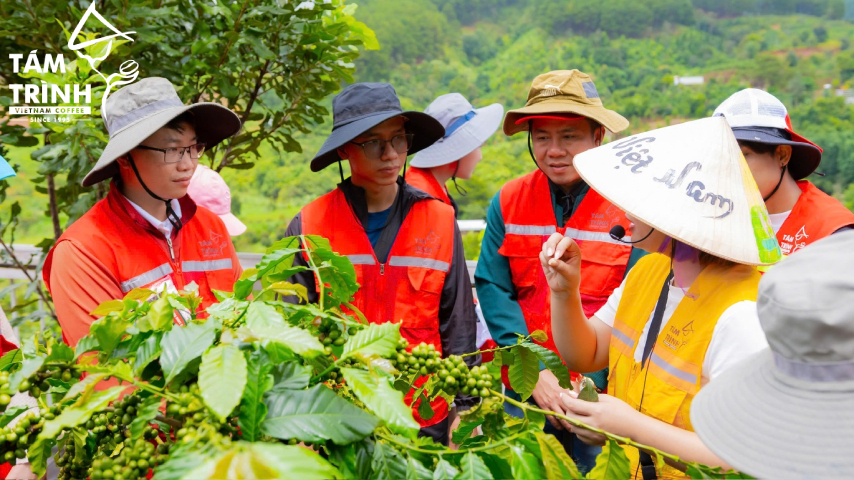
Beyond coffee production, Tám Trình Coffee offers an immersive Farm-to-Cup experience in Lam Dong.
Visitors and business partners can:
- Explore lush coffee farms
- Hand-pick ripe coffee cherries
- Tour the coffee processing facility
- Learn about roasting operations
- Brew their own coffee
At the end of the journey, enjoying a cup of pure coffee amid the scenic highland landscape provides a deeper appreciation of the value behind every cup.
Tám Trình Coffee in Vietnam’s Coffee Value Chain
As one of the major coffee processing factories in Lam Dong, Tám Trình Coffee serves as a sustainable link within Vietnam’s coffee value chain.
By managing everything from coffee-growing regions and processing technologies to modern production systems and strong B2B supply capabilities, Tám Trình Coffee provides reliable, high-quality green coffee solutions for domestic roasters and international buyers alike.
The company is proud to bring Lam Dong coffee to demanding international export markets.
Conclusion
The journey from coffee bean to cup at Tám Trình Coffee is a closed-loop process driven by passion and dedication.
Through strict control of every stage—from cultivation and selective harvesting in Lam Dong to modern processing and roasting technologies—Tám Trình Coffee delivers pure, flavorful coffee to customers both in Vietnam and around the world.
FAQ: The Journey from Coffee Bean to Cup at Tám Trình Coffee
What are the main stages in the coffee journey from bean to cup?
The process includes coffee cultivation and care, harvesting ripe cherries, processing, drying, hulling, grading, roasting, grinding, and brewing.
What does Farm-to-Cup mean?
Farm-to-Cup refers to the journey from the coffee farm to the final cup, highlighting the origin of the coffee, processing methods, the role of farmers, and the consumer experience.
Is Tám Trình Coffee a coffee processing factory?
Yes. Tám Trình Coffee operates a coffee processing facility in Lam Dong Province and specializes in supplying and exporting green coffee beans.
Tám Trình Coffee Is a Coffee Processing Factory
How many farmers does Tám Trình Coffee work with?
Tám Trình Coffee currently partners with more than 3,000 coffee-growing households in Lam Dong.
What coffee products does Tám Trình Coffee process?
Tám Trình Coffee supplies Robusta and Arabica green coffee beans processed using Natural, Washed, and Honey methods.
Why are green coffee beans important in the coffee journey?
Green coffee beans are the foundation of the roasting process. Their quality directly affects flavor, consistency, and the final value of the brewed coffee.
Can visitors experience the coffee journey at Tám Trình Coffee?
Yes. Tám Trình Coffee offers a Farm-to-Cup Coffee Tour where visitors can explore coffee-growing regions, processing methods, roasting techniques, and coffee tasting experiences.